




Why Drink Hydrogen Water? What Research Explores
Published research has explored molecular hydrogen in relation to exercise, oxidative stress, hydration, and other areas of human biology; this article summarizes those research questions without making a health recommendation. Scientists have discovered that H 2 water contains dissolved molecular (diatomic) hydrogen. Researchers study its chemical behavior and measure outcomes in laboratory, animal, and human settings. These settings ask different questions, and the existence of published research does not establish a benefit from drinking any specific water.
Molecular Hydrogen in Natural Springs
Around the world, there are natural water sources or springs discussed in historical and scientific accounts Scientists have recently found H 2 in samples analyzed from Nordenau (Germany), Tlacote (Mexico), and Hita Tenryosui, Japan1-3. The existence of H2 in these springs (and others) could be a result of water reacting with alkali-earth metals, or from molecular hydrogen, gas-producing bacteria and algae4. Researchers have proposed that molecular hydrogen may help explain some measured properties of these springs; this is an area of ongoing study.

What is Molecular Hydrogen?
Hydrogen is the lightest element on the periodic table. A molecular hydrogen (H2) molecule consists of two hydrogen atoms and is a small, colorless and odorless gas. Researchers investigate how it moves through membranes and tissues, including experimental studies of cell compartments and the blood-brain barrier. These studies do not by themselves establish how much dissolved hydrogen reaches a particular tissue when someone drinks hydrogen-rich water, or demonstrate safety or clinical benefits for consumers.
Molecular Hydrogen Research.
The body of research regarding molecular hydrogen and health-related measures has advanced in recent years through studies by researchers around the globe. Over 1,000 peer-reviewed articles have examined H2 in humans, animals, and individual cells. The literature includes molecular, physiological, and disease-model outcomes across many organ systems; results vary by model and endpoint. H2 is studied in three broad areas:
- Laboratory research has examined whether H2 converts hydroxyl (OH-) radicals to water (H2 + 2 OH – > 2 H2O); this proposed mechanism is not a demonstrated human outcome.
- Studies have measured antioxidant markers and homeostasis alongside H2 exposure; results vary by model and endpoint.
- Research has examined H2, cell signaling, cell metabolism, and gene expression, including pathways related to inflammation, obesity, and aging biology.
Molecular Hydrogen: Safety and Delivery
The human body naturally produces small quantities of H 2 gas, but that fact does not establish the safety or efficacy of any product. Some studies compare different H2 concentrations, while others use H2-infused water as a delivery method; interpretation depends on the design and endpoint. H2 research continues to examine possible practical applications. H2 ionizers and generators are consumer delivery technologies, not medical devices.
“The effects have been reported in essentially all organs covering 31 disease categories that can be subdivided into 166 disease models, human diseases, treatment-associated pathologies, and pathophysiological conditions of plants with a predominance of oxidative stress-mediated diseases and inflammatory diseases.”
~Medical Gas Research 2015; 5:12
Research Questions About Molecular Hydrogen
It is not an overestimate to say that hydrogen water’s' impact on therapeutic and preventative medicine could be enormous in the future.”
~Free Radical Research 2010. This is a historical research hypothesis, not evidence of clinical efficacy or a claim for any water product.
Why Researchers Study H 2 and Oxidative Stress
Chronic oxidative stress is discussed in research on aging biology and disease models. Many antioxidants have been studied in controlled trials, with results that vary by intervention and endpoint. Researchers have proposed H 2 as a novel antioxidant hypothesis; studies continue to evaluate its possible mechanisms rather than establish therapeutic or preventive applications.
- Researchers compare the small molecular size of H2 with larger antioxidants and study its movement through experimental membranes; claims about DNA, RNA, or protein protection require direct evidence.
- Chemistry studies examine whether H2 reacts with free radicals and forms water; implications for cellular hydration are hypotheses that depend on concentration and biological context.
- Some experiments investigate selective reactions between H2 and reactive species; “good” and “bad” radical descriptions are research shorthand, not a guaranteed human effect.
H2 and Healthy Aging: What Research Explores
Research examines oxidative-stress markers, aging biology, and disease models; those findings do not establish that lifestyle or H 2 water reverses aging or improves health. Studies continue to investigate possible relationships between H2 water and aging-related measures.
Molecular Hydrogen and Inflammation Research
- Studies have explored molecular hydrogen and inflammatory and pain-related pathways. Some experiments have measured inflammatory markers or gene-signaling pathways after H2 exposure; these findings do not establish an anti-inflammatory treatment.
- Research has examined molecular hydrogen and cognitive-function pathways. The brain is 2-4% of body weight but uses a substantial share of inhaled oxygen. Researchers study oxidative-stress markers in brain tissue and investigate whether molecular hydrogen reacts with certain reactive species; these experiments do not establish an effect on human brain health.
- Studies have examined H2, cell signaling, cell metabolism, and gene expression, including inflammatory, allergic, and cell-death pathways; these observations do not establish a product effect.
- Studies have examined whether H2 exposure changes measurements of endogenous antioxidant systems, such as glutathione peroxidase, superoxide dismutase, and catalase. These enzymes and related proteins participate in responses to reactive species. Results from cells or animal models do not establish that a hydrogen-water product protects human cells or changes health outcomes.

Exerciser? Athlete? H 2 in Exercise Research
Athletes and people who exercise experience more oxidative stress than sedentary individuals. They are also more vulnerable to the effects of chronic dehydration.
- Exercise studies measure ATP and energy-metabolism outcomes alongside H2 exposure; ATP is the cellular energy currency, but a measured outcome does not guarantee higher energy or performance.
- Studies in athletes have measured lactate, fatigue, performance, and recovery time after H2 exposure; results vary by protocol and do not establish faster recovery.
- Researchers investigate H2 and oxidative-stress markers in exercise models, including possible interactions with reactive species in sub-cellular compartments.
- Hydration studies compare H2-infused water with other water types and may measure cellular or fluid-balance markers; absorption and hydration findings vary by study.
Exercise research uses varied protocols: participants may receive hydrogen-rich water before or after activity, while comparison groups receive another water type or placebo. Researchers can measure lactate, perceived exertion, time to exhaustion, ATP-related markers, hydration indicators, and oxidative-stress biomarkers. These endpoints are not interchangeable, and a difference in one measure does not demonstrate a meaningful change in another. Small samples, short follow-up periods, training status, exercise intensity, and water composition can all affect results. Readers comparing studies should check the participant population, dose, timing, comparator, and statistical uncertainty before drawing conclusions. The cited papers provide context for the questions being studied rather than a guarantee for every exerciser or every device. Timing, preparation, and storage can influence measured hydrogen concentrations and should be reported when studies are compared. To summarize, whether at work or play, old or young, healthy, or unhealthy, H 2 is being studied across exercise, oxidative stress, aging biology, and other areas. Different delivery methods and proposed mechanisms are evaluated in different study designs; the evidence does not establish therapeutic benefits or a universal product outcome. Readers should review the cited research and discuss personal questions with a qualified professional. H2-infused water is one delivery format used in the literature.
References:
- ZHANG, J. Y., LIU, C., ZHOU, L., QU, K., WANG, R. T., TAI, M. H., LEI, J. C. W. L., WU, Q. F. & WANG, Z. X. (2012). A Review of Hydrogen as a New Medical Therapy. Hepato-Gastroenterology 59, 1026-1032.
- SHIRAHATA, S. A. N. E. T. A. K. A. (2002). Reduced water for prevention of diseases. Animal Cell Technology: Basic and Applied Aspects 12, 25-30.
- SHIRAHATA, S., HAMASAKI, T. & TERUYA, K. (2012). Advanced research on the health benefit of reduced water. Trends in Food Science & Technology 23, 124-131.
- CONRAD, R., ARAGNO, M. & SEILER, W. (1983). Production and consumption of hydrogen in a eutrophic lake. Applied and Environmental Microbiology45,502-10
Ready for cleaner water?
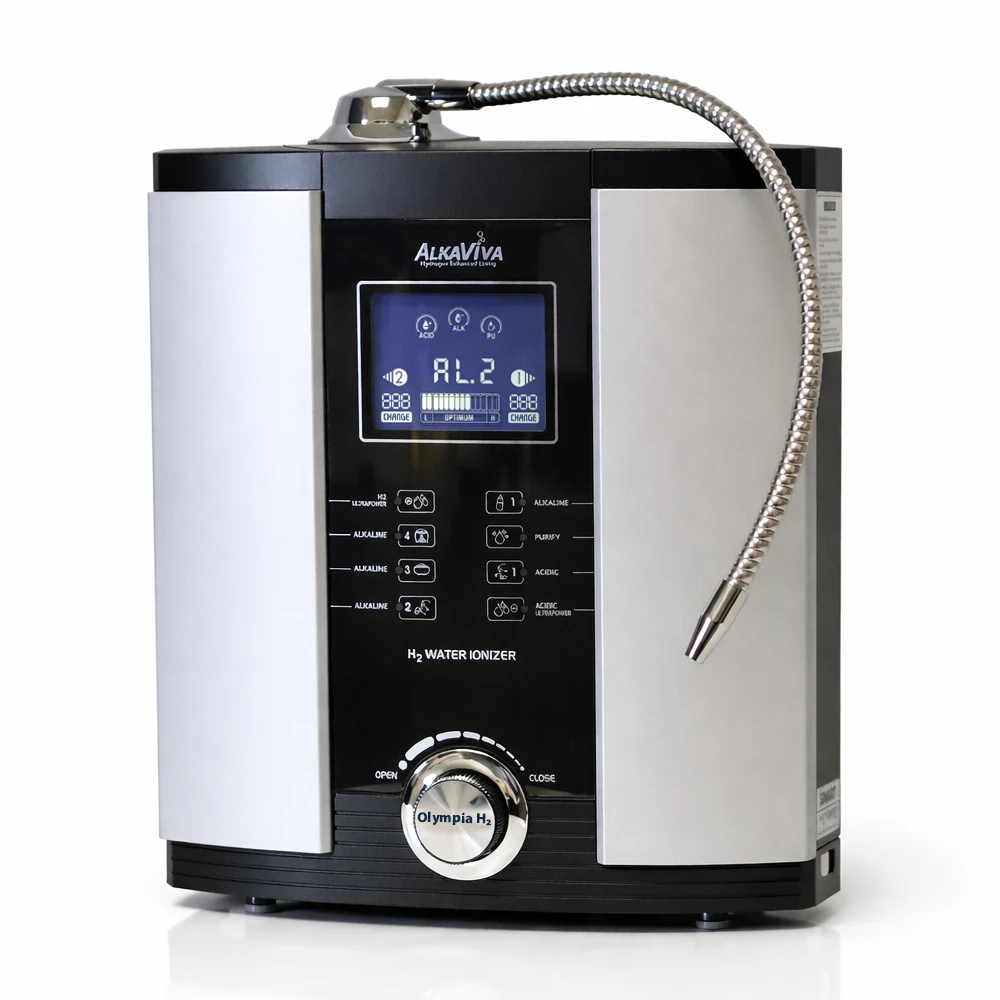


This content is for educational purposes only and is not intended to diagnose, treat, cure or prevent any disease. AlkaViva water ionizers are not medical devices.