



Water Ionizer Plates / Electrodes: The Heart of the Matter
We drink alkaline ionized water for the healthy properties. The electrodes create the ionization which deliver those benefits. When it comes to ionizers, understanding electrodes is like understanding the importance of your cardiac system to your overall health.
The water cell is the heart of an ionizer. It consists of a series of electrodes (plates), each separated by a membrane. This page will explain how electrode technologies differ and what that means to ionizer performance and ultimately your health.
AlkaViva gives a lifetime guarantee on the H2 Series ionizer plates, along with an assurance that they will easily outlast those of competitive brands.
What you need to know about electrodes...
There is so much hype and misinformation about electrodes. You will hear bigger and/or more are better. One advertises 13 plates and 800 watts. We are ionizing water, not powering 20-inch sub-woofers! Bigger or more plates or more power really means inefficient engineering, low quality materials and poor manufacturing – NOT better performance. Consider this too: more power means more heat which breaks down the platinum plating faster resulting in poor performance.
There is hype too around plate type. Performance is not about the plate type, but rather the sophistication of the engineering and the quality of the materials and manufacturing. Educate yourself on some basics and you will easily see why our Smart Electrodes offer advanced engineering, along with quality materials and manufacturing. This means more efficient performance and lasting durability.
Smart Electrodes
-
Smart Electrodes start with high-quality materials. We use certified 99.9% pure titanium from Japan and high-quality platinum. There is a myth put out by an MLM company that their plates are medical grade, but there is no such thing as medical grade titanium.
-
The electrodes are engineered using an advanced flat design that offers more effective surface area than slotted or mesh plates of the same size.
-
The electrodes are robotically electro-plated using a proprietary technique. A computer-controlled robotic arm applies the platinum under pressure, multiple times and from different angles. This allows precise plating application. The resulting plate surface can direct a uniform electron flow and provide efficient power saturation.
Our proprietary electroplating process and the resulting Smart Electrodes feature technological advances and enhanced performance characteristics which allow superior ionizer performance in the following ways:
Superior platinum adhesion
Superior conductivity which allows for lower power and higher efficiency
Increased surface area; up to 3x the number of vertices as smooth dipped plates
Optimized water flow dynamics over the plate surface due to vertices
Ready for cleaner water?


Electrode Types / Composition
Material Composition
Titanium is the base material in every ionizer electrode/plate because it has proven safe and effective. It is corrosion resistant, has a high strength-to-weight ratio, is durable, and demonstrates the ability to easily change polarity, which is important in the ionization process.
The best ionizer plates are coated with platinum because it was determined in a 1992 study by the Japanese Ministry of Health, Labor and Welfare, that platinum is the only entirely safe material to use in water ionizer plating/coating.
Electrode Types
There are three basic types of plates:
-
Flat Plate: The most common, basic and simple plate design.
-
Mesh Plate: A more recent and technically advanced configuration.
-
Slotted or “Hybrid” Plate: A less expensive and less effective version of mesh plate technology.
-
Smart Electrodes: Next-generation electrodes incorporate the best of each design.
Regardless of what you read, the most critical part of an electrode is not the type but rather how the electrodes are engineered, what materials are used and how they are applied or manufactured.
Mesh or Solid Plates?
Trust Our Experience
We have led the industry in the evolution of plate design. Our oldest models used solid plates. We introduced mesh into the market in 2006, and in 2015 we introduced our Smart Electrodes. In our 15+ years we have tested, sold and serviced all plate designs. We strive to achieve excellent top-end performance and, importantly, performance that lasts over time. Here is what we have learned.
Different Plates. Different Results.
Electrolysis plates – or electrodes – deliver the electrical current to the water which creates the desired alteration. Every company touts its own plate design. Some tout plate size. Some the number. Some both. The reality is that ionizer performance does not depend on those alone. Technologically, the conductive quality of the plating surface (effective surface area), membranes, power delivery and flow rate are all critical factors.
Traditional Flat Plates (oldest design)
Traditional flat (or solid) plates are the oldest design and were used in our earliest models. They are still used in Kangen models and others. They offer the largest surface area and are less susceptible to forming scale. However, they deliver inconsistent power saturation as there is nothing to organize the flow of the current, which takes the path of least resistance.
Think of a flat plate as a flat garden and the current as water. When you water a flat garden, water runs to the low spots and pools. So too does the current in flat plates. Because of this pooling, they have less effective surface area and are less efficient, requiring more power. High power can create heat that degrades the plating and decreases performance over time.
Slotted and Mesh Plates (older design)
We were responsible for launching the mesh plate revolution in 2006 and sold them for over a decade. We have tested but never sold slotted plates. Mesh and slotted plates use the same principle. They employ a grid pattern to create a more defined path for the current to flow, with consistent distribution.
Think of watering a garden tilled into rows. Water channels into the rows, ensuring more even distribution. Even power distribution means better results with less power.
However, due to the voids in the grid, they can have less surface area. Some companies overpower their plates trying to get more performance, which can hurt long-term performance. Also, due to the many nooks and crannies inherent in the grid pattern, they can be more susceptible to inconsistency in plating thickness and are more likely to form scale in hard water areas.
The Next Generation: Smart Electrodes
What if you could combine the best attributes of each design and have the best of all worlds? Smart Electrodes are manufactured using a proprietary new technique. Robotics are used to electro-plate the platinum multiple times under pressure and from different angles, creating a unique grid-like pattern. This allows a uniform flow of current and provides efficient power saturation.
Our new Smart Electrodes offer you:
-
A new solid-plate coating technique that delivers thick, uniform plating and even power distribution.
The largest effective surface area.
More current to the water for better performance.
More efficient, lower power levels that reduce heat and degradation.
None of the design drawbacks that come with the nooks and crannies in mesh plates.
Superior performance, especially over time.
In short, you get the benefits of solid and mesh in one new plate design.
Dipped or Sprayed?
Plating or Dipping
Long-term research and development findings derived from a 1992 study by the Japanese Ministry of Health, Labor and Welfare indicate platinum to be the only entirely safe material for use in water ionizer plating/coating.
Two distinct methods – plating (dipping) and coating – are employed to apply the platinum surface to the titanium plate:
Plating: Also known as cladding or dipping, plating is the process by which a titanium plate is submerged in a platinum solution. This is the most commonly used manufacturing process due to its cost efficiency.
Coating: Also known as electroplating, coating is a technically advanced process designed to achieve a higher degree of consistency and uniformity.
The two biggest differences between plating and coating are:
The amount of titanium crystals produced
The surface coverage characteristics
The following examples visually illustrate two distinct platinum application techniques: plating (dipping) and coating (electroplating).
Plating or Dipping – Both dust and voids are clearly visible
Plate surface from above: Black spots represent voids.
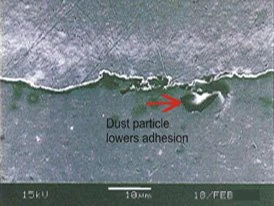
D/H company – Dipping method
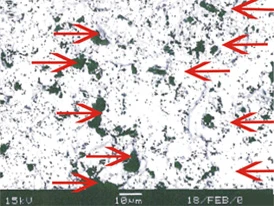
D company – Dipping method
AlkaViva Coating (Electroplating)
Note the distinct vertices (peaks and valleys) and a three-dimensional crystalline surface, as compared to the inconsistent surface of the dipped electrodes.
Plate surface from above: No voids, thin spots or inconsistencies.
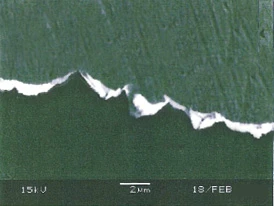
AlkaViva plate – coated platinum
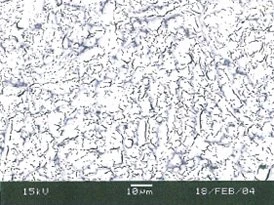
AlkaViva plate – coated platinum
Plate Leaching
AlkaViva states that it is able to prevent titanium leaching on the electrodes by two methods:
-
Complete and uniform coverage. The coating process is designed to cover the titanium plates with pure platinum, including all edges and surfaces.
-
More efficient use of power. Lower power use creates less heat and stress on the plate during electrical load phases.
View a certified analytical test result from the United States Environmental Protection Agency Primacy Laboratory for the State of Nevada showing that there is no leaching.
Optimal Results Without Additives
AlkaViva employs proprietary technologies which are able to achieve optimal alkalizing and acidifying results without the use of solutions such as salt enhancers.
Importance of Membranes
It isn’t ALL about Electrodes: Membranes
All ionizers employ ion-absorbing membranes to separate the electrodes and enable the water to ionically separate into an alkaline and acidic stream. The membrane is absolutely critical in how an ionizer performs. You can have a well-designed plate, powered optimally, but if you have poor membranes, then you have poor performance.
Other ionizer manufacturers buy their membranes from outside sources. In comparison, AlkaViva’s Infusion Membranes are made in-house and are ultrasonically pressed, rather than chemically bonded. This provides a membrane designed to work specifically with Smart Electrodes.
Summary
Our competitors use more watts and amps, spreading the same input voltage over a larger surface area, which results in less efficiency. They do not deliver the power evenly or efficiently and must do so with greater resistance.
More power means more heat, which means the platinum plating breaks down faster on the surface of the electrode. This equals poor performance over time.
So now you can see that bigger is not better. This is why the electronics industry and others have shown that when technology advances, it typically results in smaller, more powerful devices. Why would ionizers be any different? The truth is they are not.